Showing posts with label Pasadena Advertising Marketing Design. Show all posts

Friday, August 24, 2012

Creative, Schmeative. Impact Rules!


That may seem an odd sentiment for a creative agency. Especially since there is nothing we enjoy more than taking words and pictures and bringing them to life in new and exciting ways. But we do expect our creations to turn people’s heads. And we love it when what we created sticks with our audience, and changes they way they think.


We just found out that this year we turned more heads than even anyone had anticipated for The Orange County Transportation Authority (OCTA). They asked us to use Rideshare Week to kick off a first-ever, year-long, cohesive, sustainable alternative transportation message that would excite commuters about using OCTA’S alternative transportation initiatives. We made it our goal to get solo commuters out of their cars and into busses, trains, vanpools, carpools, biking walking. Specifically OCTA asked us to increase participation in their annual Rideshare Week program by 15% – a 5% increase over their previous year’s increase of 10%.
 “No problem,” we lied, and we immediately set out to solve the problem. We scoured OCTA’s Awareness and Attitudes Studies, boarding reports, ridership trends, boardings, StationLink routes, and National Transit Cooperative Research Program (TCRP) studies. Bit by bit we laid the foundation for the core message that would unite all the promotions, marketing events, materials and interactive resources for this year-long campaign. Taking our cue from TCRP studies, we designed this campaign to appeal to commuters directly, (rather than corporate transportation coordinators) for maximum impact.
To attract commuters from all walks of life, we created a heroic silhouette that was ageless and raceless: an illustrated everyman who set the style and branding image for all the promotions to come for the rest of the year. All the graphic elements promoting the Rideshare program were designed to be visually stimulating, compelling and memorable. Simple yet elegant icons of transportation gave equal weight to all the alternative transportation options.
OCTA named the hero image the “Ridesharer.” This campaign image appeared in all media, in print, on busses, on workplace posters, postcards and handouts, as well as on the web, on Powerpoint presentations and in email blasts, to reinforce the central message of empowerment no matter where the audience was or where they were looking.
Additionally, in accordance with the TCRP findings, OCTA’s VanPool effort was made easier for commuters with our interactive Seatfinder application which made joining existing vanpools and establishing new VanPools vastly easier.
When all of the figures were compiled and analyzed, the overall effectiveness of the 2011 Rideshare Promotion Campaign was remarkable. There was a 134% increase in pledges over the previous year, and it turned out to be the most effective Rideshare promotion ever. As an added bonus, vanpool participation nearly doubled even before the beginning of the vanpool week promotion.
Speaking from a “creative” point of view, impact is what it's all about.

Wednesday, August 8, 2012

One and a Half Months in 4 Minutes and 27 Seconds

Every move is fraught with delays. Trucks are late. Things get broken, lost, misplaced or (the politically correct word for:) stolen. Everyone expects this. Everyone deals with it. You just double the estimated amount of time predicted and learn to live with it.  It takes a lot to make a move truly "memorable."
Welcome to a memorable move. Between rebuilding two offices, resetting a contractor's broken finger and two broken toes, a bout with the flu for most of the crew, plus old plumbing, ducting, electrical and a monster ethernet network nightmare, our move of just under 7 blocks took almost exactly 2 1/2 months to complete. You have to laugh. 

Moving out of The Palace Livery and into the Original Chamber Building leaves us Unstabled.

Our new home, the original Chamber of Commerce Building is in one of the most beautiful buildings in the City. Constructed in 1906, it is a prime example of Beaux Arts architecture and the first "modern" steel frame building in all of Pasadena, and one of the first west of the Mississippi. It was also revolutionary in its design. The office towers were designed to maximize the effect of natural breezes for cooling. The U-shaped design surrounded a central atrium that assured there was always a shaded section at all times of the day. The central atrium was used mainly for deliveries, but was also a light and airy place to relax during hot and hectic days. The flow-through design utilized windows on the outside with transoms over the internal doors to make the most of the slightest breeze.
In 1988 this building was the first home to Pasadena Advertising (then The Pasadena Agency), We were one of the first tenants of the Chamber Building after a complete restoration by our good friends Gene and Marilyn Buchannan, and it marked the beginning of a long association with hundreds of other visionaries and developers dedicated to the restoration of Old Pasadena. A success story we are immensely proud to have been a part of.
As for the move itself, it was exciting, frustrating, educational, occasionally painful (and, of course, smokey), and ultimately extremely rewarding.  Or, in short.
We've decided never to move again. =)

Tuesday, June 26, 2012

Our New Old Home Sweet Home


We’ve moved. We went through miles of tape and enough boxes to build a cardboard super highway to the moon. After 17 years – even in a renovated livery stable – it's amazing what you can amass.
Now from our humble stable, we’ve moved into one of the grander examples of Beaux Arts architecture in Southern California. Our new offices, at 117 E. Colorado Boulevard in the heart of Old Pasadena, are a part of history. In 1906, ironically the year of the great San Francisco earthquake, this was was the first steel framed building in Pasadena, and one of the first west of the Mississippi.

The original Chamber of Commerce Building in the early 1900's with the Red Cars on Colorado Blvd.

This innovative building fell into disrepair along with all of what is now Old Pasadena in the 60's and 70's. For decades, the only traffic on Colorado Boulevard was drug traffic. However, in 1986, Gene and Marylyn Buchanan completely renovated the building, enclosing the central atrium, making the most of the building’s natural “green” cooling structures with the addition of air conditioning and thermal venting. It was an auspicious beginning to what is today Old Pasadena. It was a part of an effort embraced by hundreds of concerned citizens who joined together to rehabilitate the old downtown to it’s former glory.

The Chamber of Commerce Building Today with the same charm, but with a helipad on the roof.

It was also a new beginning for Pasadena Advertising (then The Pasadena Agency), as it was our first professional building after we moved out of the office over our garage. We were one of the first tenants of the old Chamber of Commerce Building, and it marked the beginning of a long association with the rebuilding and maintenance of Old Pasadena.

Suite 165, the (almost) finished lobby of Pasadena Advertising Marketing Design
You can read the whole story on our website, Where we Work page. Of course you are welcome to visit at any time. Just give us a call at 626-584-0011, and we will take you on a tour.

Monday, April 30, 2012

Bike-To-Work Week, er, Month, um, Year

The Orange County Transportation Authority Bike to Work promotion officially starts Sunday, April 29, 2012 with a bike festival in Huntington Beach. However, National  Bike Month has to wait its turn for another 2 days, because it, officially, only happens in the month of May. 

Our National Bike Month Poster for OCTA
For years, this celebration was widely known as Bike To Work Week (which is still going on). This month, Bike To Work Week is May 14 - 18. However this is the year that OCTA asked us to use the month of May to kick off a year-long effort to get people out of their cars and onto their bikes to go to work, to shop, to school and to play. And while I'm sure a substantial number of you reading this are shaking your heads saying, "No that's impossible," I have to remind you that I have been doing it for over 17 years. And I know that some of you must be thinking, "Well, that all well and good for you young folks, but I'm too old for that." Fine. Then, using my age as a guideline, if you're over 67, you can use that excuse… at least for another year.
Everyone at Pasadena Advertising is proud that we were chosen to be a part of this effort, and OCTA is doing their best to make this year's program truly excel. Their theme this year is "anyone can bike" (as I believe I have proven myself). And among the benefits they are pointing out, the cost savings alone should provide more than a little motivation. The savings amount to thousands of dollars a year. In this economy, that is huge. But another benefit of course is health. For those of us who work so hard we can't find time to get to the gym, how about getting in a one-hour workout in 20 minutes?
My 6-mile round trip to the office by car is about 40 minutes. The round trip by bike, is around an hour. So in just an extra 20 minutes a day, I get in a full hour's workout. And I don't stand in line. And I don't have to put up with people using my soap, shampoo, towel, and whatever else they accidentally get their hands on. And did I mention that I can vary my route and enjoy a different ride every day? And that it's free?
So dust off your bike, and give your car a rest. Have fun.  Get healthy.  Click here for more information about OCTA's National Bike Month celebration. 

Sunday, September 11, 2011

All Kirk Sellman wanted was to play with his 3-year old again

For over a decade, Kirk had put up with numbness, first in his feet, then his legs and finally all of his lower organs. But for over a year, things were going south rapidly. He fell often and fell hard. He frightened his 3-year old, and was in fear for his life. When the neurologists and neurosurgeons at USC examined his CAT scan, they found a tumor that had compressed his spinal cord to the thickness of a ribbon.


Kirk relates this experience of facing the consequences of a thoracic vertebra 7 level schwannoma, and his treatment, a gross total resection of the tumor by neurosurgeon, Patrick Hsieh, M.D. Graphic scans show the extent of the damage done by the tumor and the relief that Doctor Hsieh and his team were able give Kirk. More than just the ability to stand, and walk and regain control of his body. He was able to rebuild his life and rejoin his family.
This is just one of thirteen videos that Pasadena Advertising Marketing and Design produced for the USC Keck School Of Medicine: true stories of normal, healthy people whose everyday lives were suddenly shattered by catastrophic medical emergencies no one could predict or prepare for.  The patients themselves tell their stories of survival with the help of their doctors: the neurologists, neuroradiologists and neurosurgeons of the Keck School of Medicine at USC.
This is the kind of information my wife and I wished we'd had when our daughter’s life was nearly ended by a brain hemorrhage in Scotland in 2007. We spent hours pouring over the Internet scouring all the information we could find on aneurysms and the treatment, coil embolization. Most of what we found was so arcane and technical that we could not truly grasp what was happening. We created these videos for people like us – people who need immediate answers, to urgent questions, in idioms they can easily understand.
With these videos at their fingertips, patients, friends and families dealing with life threatening neurological threats will finally have a place to turn for practical answers that they can understand.

These videos were conceived and produced by Tony Nino and Suzanne Marks at Pasadena Advertising Marketing Design.
The director and DP was James OKeeffe and the editor was Peter Bayer.

Monday, June 20, 2011

Mobile Commerce: HUGE or tiny. Yes!

Two MediaPost articles caught my eye this morning. One on M-Commerce derided the minuscule $6 billion in sales that retailers can expect this year from mobile sales, and projected a paltry $31 billion by 2016. The other on SmartPhone data use, trumpeted that smartphones had almost doubled their data access over the last 12 months from 230 MB to 435 MB - and that's not counting tablets and e-readers.

On the face of it, those numbers don't seem to add up. While data use rises exponentially, mobile sales creep up arithmetically. You have to wonder if those two writers even speak to each other… until you notice that they are one in the same, Mark Walsh.

However, when you read further down in Mark's M-Commerce story, two paragraphs jump out at you:

Despite rising smartphone adoption and the burst to roll out new mobile payments, mobile "shopping" often isn't about buying. When consumers use their phones, it's usually to get product information or compare prices -- rather than actually completing a transaction. Shopping never ranks high on any list of Web activities.
Furthermore, retailers are not spending much to optimize their sites for mobile. They are also confused about the best way to approach the medium -- the mobile Web versus apps conundrum. While most retailers have not pursued apps, the potential for location-based services and other tools enabled by more sophisticated devices cannot be ignored.

So, it's not the technology or the adoption rate that is curtailing mobile commerce, but rather Retailers' inability to keep up with the technology. In fact, Marks writes, the "innovation is likely to drive paralysis" as retailers struggle to find vendors and partners who understand this rapidly changing landscape.

Part of the conundrum is that mobile commerce isn't as much about electronic purchasing as it is about in-store shopping. In lieu of those bygone days of knowledgeable human assistance, people use their phones to compare products and prices. Most retailers are singularly unprepared for the convergence of e-commerce and in-store interaction. And many consider their in-store and e-commerce (mainly web) departments as competition.

Ironically, in this economy, when retailers have the least time and money to spend straightening that out, those who spend the most, most wisely, will spring ahead of the others.

IMHO
Tony Nino
Pasadena Advertising Marketing Design

Wednesday, June 8, 2011

WINNNINGGGGG!

No, really. We won!

Pasadena Advertising Marketing and Design, working with Green Street Ads, has won a yearlong contract with the Orange County Transportation Authority (OCTA) to get people to give up riding alone in their cars. Our silent partner is of course the oil companies whose 4-bucks-plus for a gallon of gas is an excellent motivator to get solo drivers to strongly consider alternatives.

In the spirit of full disclosure, I admit I’ve been into alternative transportation for well over a decade. It all started off with riding my bike to work one day every week, then two days, then three, four and finally five. Now I get in between 60 and 100 miles every workweek depending on the weather and whether or not I have time to take a loop around the Rose Bowl. In addition to staying in shape and looking smashing in Spandex (as long as you keep your eyes closed). And I figure I’ve saved between $2,500 and $3,000 a year in gas. Those alone are not bad motivators.

For this contract, we are working together with fellow biker and long-time cigar buddy John Espinoza and his crew at Green Street Ads. We’ve worked together before on projects for Old Pasadena Management District and the Pasadena Department of Transportation. OCTA promises to be even more interesting. They have a great story – beginning with a wealth of alternatives to driving solo: Standard bus and rail services, a robust “Share the Ride” ridesharing database, a vanpool program, very efficient carpool matching services, employer transportation plans, and an extensive network of bike paths, lanes and routes. And they’re open to having fun.

Fun is good. Fun is a key ingredient to success in many media, but social media most of all.  With Facebook, Twitter, podcasts, blogs, and YouTube, the more fun, the more powerful the impact. If we make real fun an integral part of our events and promotions, that can play out in other media as well, and OCTA has set its sights on a broad media mix. We’ll be in traditional and electronic media ranging from print and broadcast to billboards and bus shelters, as well as in some pretty unconventional places. Drivers in Orange County are going to find our message in front of their eyes no matter who or where they are.

Our first meeting is July 1st.  Can’t wait.

Wednesday, May 4, 2011

The Story of Kelly Mitchell


Every expectant mother has doubts. Will she be a good mother? Will she make the same mistakes her mother made? How can she protect her baby from harm? Never do expectant mothers ask what happens if an undiscovered brain tumor threatens both her life and the life of her baby, or whom does she turn to for help.


Well into her seventh month, Kelly Mitchell began experiencing symptoms that were way beyond anything her mother had ever warned her about. Beyond the nausea, daily milkshake cravings, and frequent bathroom visits, she began to encounter severe memory lapses and loss of vision. After visiting numerous doctors and specialists, an MRI revealed a terrifying development. She had a Craniopharyngioma, a benign brain tumor that, while not cancerous, was approximately the size of an avocado. She desperately needed a craniotomy, an hours-long, open brain surgery that would threaten the life of her unborn baby.
In this video, Kelly tells the story of her journey through this terrifying time. She felt her memory slipping away and her vision fading with each passing day. Her neurosurgeon, Dr. Charles Liu, USC Keck School of Medicine, explains the issues surrounding the precise timing necessary for the Pterional Craniotomy to save the lives and quality of life for both mother and baby. Setting the exact date was crucial, and there was virtually no room for error. He worked closely with her OB GYN to determine the earliest possible date to deliver her baby, and leave enough time for  surgery before the ever-increasing pressure of the growing tumor caused irreparable brain damage. 
This is just one of thirteen videos: true stories of normal, healthy people whose everyday lives were suddenly shattered by catastrophic medical emergencies no one could predict or prepare for.  The patients themselves tell their stories of survival with the help of their doctors: the neurologists, neuroradiologists and neurosurgeons of the Keck School of Medicine at USC.
This is the kind of information my wife and I wished we'd had when our daughter’s life was nearly ended by a brain hemorrhage in Scotland in 2007. We spent hours pouring over the Internet scouring all the information we could find on aneurysms and the treatment, coil embolization. Most of what we found was so arcane and technical that we could not truly grasp what was happening. We created these videos for people like us – people who need immediate answers, to urgent questions, in idioms they can easily understand.
With these videos at their fingertips, patients, friends and families dealing with life threatening neurological threats will finally have a place to turn for practical answers that they can understand.
For more information contact USC Neurosurgery.

These videos were conceived and produced by Tony Nino and Suzanne Marks at Pasadena Advertising Marketing Design. The director and DP was James OKeeffe and the editor was Peter Bayer.

Attention Small Businesses

Under the general heading of "Important Safety Tip," this falls right under "Don't cross the streams."
According to the Center For Media Research, 37% of small businesses are not planning to survive this year, they are planning to GROW. And they're exploiting social media to do it.
Good strategy? Signs point to a definite "maybe." But we are seeing other signs that this might be the right time, including an AP analysis that shows a dramatic lowering of economic stress.
Not advising anything rash, just pointing out things that are going on.
Don't we live in interesting times?

Tuesday, March 8, 2011


This is a copy of the Powerpoint presentation that Suzanne Marks and Tony Nino gave to the Southern California Regional Rapid Response Roundtable in January. These are the people who corporations and laid-off workers turned to as the economy disintegrated. They helped the corporations survive during the economic meltdown, and helped their laid-off employees find new employment opportunities. Now that the economy is recovering, these are the same people who can help employers find the right applicants, as well as help job seekers find the perfect jobs.
When it comes to low-cost, high-impact ways to connect employers to job-seekers, few tools are more powerful than Social Networking. There is a virtual toolbox of applications that can the reach across a broad array of demographics with remarkable results. The meteoric rise of Facebook, Twitter, Linked-in, mobile apps and sites, blogs, YouTube, e-news distribution, SMS messaging and e-surveys has led to a kind of intense personal trust and involvement formerly only attributed to the all-powerful word-of-mouth advertising and personal references.
However, to reach the majority of decision makers and influencers, you’ve got to go Mobile. According to OnlineMedia Daily, this is the year that mobile-enabled and mobile-friendly websites have gone from merely useful to essential. Our client, FWIB, the Foothill Workforce Investment Board, is embracing both social media and mobile media. Before we attended this roundtable, I did not realize how advanced FWIB was.
After our presentation, we were approached by Workforce Investment Board and Rapid Response representatives from all over Southern and Central California who said they were not allowed to use any of these tools. They were prohibited. The single most effective methods of reaching workers and employers simultaneously… for FREE!... is Forbidden. And it’s not just Facebook, Twitter, Linked-in, YouTube, e-news and SMS messaging; at least half of the representatives complained they are not even allowed to use Google! Unbelievable, but true.
As our State and states around the nation struggle to recover from the worst recession in our lifetimes, there are rules in place that undeniably slow the pace of that recovery. It is beyond me. It baffles me, but it is happening. These social marketing and outreach tools may be new, but they are not evil. At least no more evil that the hammers and screw drivers that fill our toolboxes at home. Certainly, as any self-respecting sore thumb knows, hammers can do harm. That doesn’t mean we don’t use them, especially when something needs repair.
Our State economy needs repair, and it needs it now. We have the tools to help at our fingertips. They are numerous. They are effective. They are free.
Unfortunately, they are also forbidden.


Tuesday, December 28, 2010

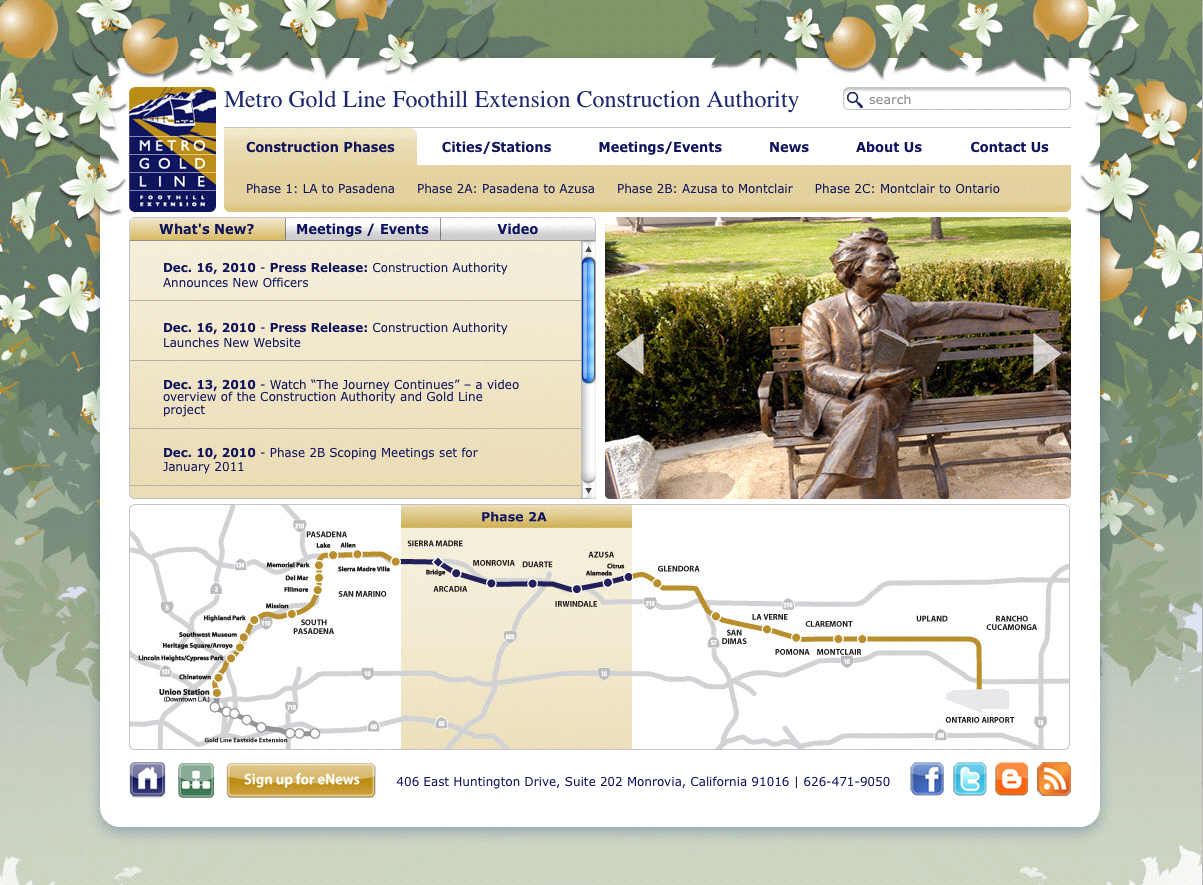
Look, Our New Gold Line Website Is On Track

Pasadena Advertising Marketing & Design has created a new content managed website for Foothill Extension Authority.
Foothillextension.org homepage
After a month of testing, The new foothillextension.org website designed by Pasadena Advertising Marketing and Design (AMD), has gone live to answer visitor's questions and point out directions simply, directly and immediately.
The Foothill Extension Construction Authority is building an extension to the Gold Line light rail that is planned to connect downtown Los Angeles to the San Gabriel Valley foothill cities, eventually extending all the way to Ontario Airport. From the website’s compelling and easy-to-navigate front page, this new design lays out the planned rail route as well as the points of interest near every city’s station along the way.
“The excitement in the Foothill Cities is growing daily, and we wanted to create a site that would justify that excitement with a graphic, interactive representation of the promise of what is to come,” explains Pasadena AMD President Suzanne Marks. “We felt is was important to capture the full spirit of the project,” adds her partner Tony Nino, “not just to help our neighbors understand the construction schedule but also to visualize the full potential of a light rail line connection to a major airport.”
Construction phase pages connect to city/station designs and nearby attractions.

“The design concept,” according to Creative Director David Ensz, “was to frame the interactive elements of the site in the graphic tradition of Plein Air artistry in the style of classic orange crate art for which the region was known.” The challenge of programming designer Luke Gschwend was daunting, “I had to create a content management system which made navigation easy and intuitive for the site visitors, yet simple to understand and update for the in-house Foothill Extension personnel."
The final site, at http://www.foothillextension.org accomplishes all of the goals beautifully. Almost all of the information visitors could want is no more than two clicks away from the home page, and for more immediate results, a search feature is available from every page.

Thursday, December 2, 2010

To look for work – and look for workers – Be Social!

[A transcript of Suzanne Marks' presentation to the San Gabriel Valley Economic Outlook Conference]

Most businesses today have spent a good deal time and money branding their businesses. The have done it in their advertising, in their corporate communications, and in their corporate culture. The most successful companies created brands have made corporate image personal and attractive to consumers, investors and prospective employees.
That same branding ethic now extends to social marketing as an avenue for your company to recruit the best new hires.  In fact, some businesses have reinforced their brand’s appeal to prospective employees by creating whole new sections of their websites, or entirely separate websites, exclusively to promote the quality of their working environment. Social media components such as Facebook, Myspace, LinkedIn and Twitter are also crucial pieces of marketing for recruits. It is an increasingly important way to search for new applicants. Companies that used to spend thousands on recruitment, can now run ads on Craigslist, Facebook and MySpace, and then lead their prospective employees to those ads by using Twitter.
Social Media is also a way for employers to more closely examine and applicants, especially those who may have revealed more about their personal lives than they should have. Employers can use that information to their benefit, however there may be downsides to that which you have to consider before using it indiscriminately to make hiring decisions. At first glance, Facebook, LinkedIn and MySpace (the top sites being screened) do appear to be a gold mine of personal applicant information. In fact, according to a recent CareerBuilder.com report, the number of companies using social networking Web sites to screen potential employees has doubled in the last year, and what they have found has killed the hire for more than a third of candidates. Currenty 1 in 5 hiring managers conduct background checks by using social media, primarily FaceBook.
Conversely, more and more network-savvy applicants have begun to use social media, blogs, and personal websites strategically to give them an advantage over other candidates.  They are branding themselves the same way companies do. They position themselves not only as someone best fit for the job, but who is also eager to work for  your company.  And the best and brightest talent also uses the Internet to review their prospective new employers with a critical eye. What does this mean for your company?
First of all, Make sure your web site makes your company attractive to new hires. This encompasses everything from: the user friendliness of your site, the quality of your products or services, your customer relations, how you do business, in other words, your brand. However, this also should include information about your internal culture, training, your hiring philosophy, benefits, and the advantages of your location.
Reinforce that with a well-maintained presence on LinkedIn, FaceBook, and Twitter that drives people to your Web site. Some new talent may think your company is old and stodgy if you don't have a presence on these social networking sites, or they just won’t notice you at all. This is especially for people in their 20s who have grown up thinking that the Internet and social media have always existed.
Develop a social media strategy to entice quality talent and to screen applicants. Be patient and stick with it. Online marketing and recruiting takes time and constant attention to see results. However, if you can position your company in your target audience’s top-of-mind awareness, you will be miles ahead of your competition in finding the highest-quality talent. It will ensure that your business will thrive well into the future.
However, as with any tool, you have to be careful how you use it. Unlike traditional hiring tools such as team interviews, calling past employers, and background checks, social networking sites exist in a legal limbo of privacy concerns. Stories from recruiters show why these sites are so enticing.
It is all to easy to search for the candidate by name and refine the search by adding the terms: Facebook, LinkedIn or MySpace and there’s no telling what you might see. Depending on their privacy settings, the quality of information available on a social network site varies. But you don’t have to stop there; you can also search blog search engines, such as www.google.com/blogsearch and business sites such as Zoominfo.
One recruiter related how she had found “The Ideal Candidate” for her firm. But when, she ran the applicant’s phone number on a search engine, up popped some explicit ads for adult services she was apparently involved in. Uh oh. In another instance an intern being considered for a permanent position had demonized his firm, his boss and his coworkers in considerable detail and by name. Obviously neither of these Rhodes Scholars was “ideal” for any position these companies wanted to fill.
As valuable as this information can be, make certain you don’t rely exclusively on such sites for your information. At this point in the evolution of e-law, there are no published cases yet on point. Lawsuits take time to work their way through the courts. However, it is all but certain that some day an employer will land in court being sued on allegations of discrimination or a violation of privacy for making use of a social networking site in the hiring process.
The conventional wisdom, is that anything online is fair game because any reasonable person must understand that the whole world has access to the internet. However, younger workers, and their lawyers, may well regard invading their social network sites in the same way older worker may regard someone who crashes a private wedding party uninvited, a act that violates privacy.
That said, when used carefully, in addition to the tried-and-true traditional hiring tools – interviews, calling past employers, and background checks, social network sites can offer valuable information. Just use common sense. The bottom line is Social Media is simply being social thru new media, over the internet and mobile networks.
People are sharing their stories and experience with friends near and far. Likes and dislikes are also getting shared and businesses are just beginning to capitalize on that. There are many ways for employers, job seekers and business to use social media for their own purposes.
On a personal note, recently we were invited in to pitch a large retail company.  I was told who was going to be in that meeting and immediately started my social media search.  I found out where they lived, worked, went to school past employment etc.  I contacted people on Linked In that were in both of our networks to put in a good word for us.  I tailored our presentation to the people in that room.

Monday, November 22, 2010

Advertising Myopia Oopsia


When I decided to write about what I call myopia in advertising and marketing, I was pretty cocky. I've been harping about this for years, and for good reason: Business owners are often so consumed with what they think their company is all about, that they neglect to question what their customer thinks. It is so common a problem, that I spend the majority of my marketing briefs describing how customer perceptions differ from those of business owners and operators. And how to capitalize on those customer's expectations.
Whereas a business might be incredibly proud of the accuracy of their wrist-mounted, certified-quartz banded chronometer, their customers don't care unless they are told why they should.  In fact customers won't be interested in the least if they don't first know that the product in question is a watch. They have to understand what the product or service means to them personally before you can tell them that it's better than all the others. Or that it is worth paying more for. It is the classic case of “What have you done for me.”
But since I'd been dealing with this issue since I first began in advertising, more than 25 years ago, I thought I'd check to see if anyone else had ever noticed this phenomenon. And (BLAST YOU GOOGLE), it turns out somebody else had.  A certain Theodore Levitt had written a paper on what he called "Marketing myopia" some 50 years ago. According to Wikipeda, "This paper was first published in 1960 in the Harvard Business Review; a journal of which he was an editor." So, I guess, I was not all that original after all.
Can you plagiarize before reading your source material... apparently...

Now, in my defense, I was not doing advertising in the 1960's. No character at Sterling Cooper Draper Pryce was based on me, not even one of Don Draper's kids. In fact, little Sally Draper was proficient at mixing drinks long before I ever could. I’ll bet, other than occasionally being kookoo for Cocoa Puffs, I was completely oblivious to advertising.
I encountered myopia in advertising and marketing quite independently when I came across clients blithely ignoring their customers, because, I supposed at the time, customers were too ignorant to matter. I came to realize later that it was simple pride. Pride of ownership. Pride of authorship. Pride of invention, development, execution and superiority, all of which are attributes worth being proud of.  Just not to the exclusion of profits. Even the most ignorant customers have money.
So, thank you Mr. Levitt for validating my observations, um… before I was able to observe them. I guess (blushing) this would be a great time for me to finally read your paper.

Saturday, October 16, 2010

Never use Translations in Your Advertising

And, on the other hand, ALWAYS translate your advertising.
Lemme splain.
The most effective kind of communication is idiomatic. Hence, the most effective advertising is idiomatic. Idioms are the connections that link a culture together, and they don't translate between cultures well. If you have a message that works well in English, you have to remember that it is working well in American English, not British English, Australian English or even Canadian English, eh? Or as George Bernhard Shaw so eloquently put it, "The English and the Americans are two peoples separated by a common language." What that means to an advertiser is: If you want to reach an new audience that speaks a different language, it is not enough to just translate the words of your message.  Even if you get all the words right, the message itself will suffer mightily.

A couple of idioms from another culture, Max and Moritz. Read more and see original image: 
http://en.wikipedia.org/wiki/File:Max_und_Moritz.JPG
One of the more amusing ways to demonstrate this is to take a common expression such as, "You can't teach an old dog new tricks." and use Bablefish to translate that into say German, which translates to: "Sie können einem alten Hund neue Tricks nicht unterrichten." Those words are basically correct, "hund" is dog, "underrichten" is teach, and "Tricks" is tricks. However if you try to translate that "German expression" back into English, you get, "They can an old dog new cheat not to inform." Um Gotteswillen! In fact, if you wanted to express that concept idiomatically to a German audience that grew up on Max and Moritz, you would say, "Was Hänschen nicht lernt, lernt Hans nimmermehr," which means, "What little Hans doesn't learn, grown up Hans will never learn." That might have absolutely nothing to do with dogs, but the idiom carries the same exact meaning to an entirely different culture. It is reminiscent of a tale told in intelligence circles about early attempts to use the super computers of the cold-war 60’s to translate Russian into English. When they put in “Out of sight, out of mind” using their algorithm, what they got back was: “invisible idiot.”
That said.
Always translate your product essentials (such as the NAME) into the language of your target audience to avoid embarrassment. If for instance you want to introduce your automobile into a new country south of our border, it would be instructive to know that the name NOVA is a colloquialism for “doesn’t run.” Then there’s Vicks cough drops which became popular in Germany, but before introducing them there, they had to change the name to “Wicks,” because they discovered that “vicks” is a rude name for a sex act. Much more recently Osco Drug Stores bought out Sav-On drugs in the predominantly Hispanic Southern California market. They were so proud of the name they had created for themselves over the decades, that they changed their store names, stationary, and advertising from Sav-On to Osco and watched their sales plummet, especially in predominantly Hispanic neighborhoods. Osco, it turned out, was an idiom usually associated with vomiting. When you’re sick, the last place anyone wants to go is Vomit Drugs.
After all is said and done, no matter what language it is said and done in, the most basic tenant of advertising applies. Know your audience. Speak their language.  Whether your audience are juniors looking for fashion or governments looking for engineers, learn their jargon, their idioms and you can talk to them in their language, no matter what language they speak.

Thursday, October 14, 2010

The Dangers of "Brilliants" in Advertising

I remember the day like it was yesterday. My client abruptly overruled every marketing strategy, product name, logo design, identity package and ad campaign concept that he had approved only a few days before. He had decided to do his ad campaign himself. He knew the product better than anyone, and he was the smartest person he knew.
Both of those statements were true by the way. He had single handedly come up with an invention that had revolutionized his industry. He was a brilliant chemist and practitioner, and had built up a million dollar company that he had started in his garage. The only thing wrong was his reasoning. He decided to undo an entire campaign and design strategy, because his "daughter didn’t like it." She was eighteen at the time.
In his defense, she was the one who had come up with the name for his company when she was twelve. My client therefore reasoned that advertising was so easy even a child could do it.  That said, however, she had not shown any inclination for marketing and advertising since that day. And for all his brilliance in his chosen fields, he himself had no concept of advertising, marketing, design, research, or packaging. And after all was said and done, to become known as the leader in his field, he needed to accomplish all of those in the worst way possible. By doing it himself that’s exactly what he got.
Within a few short years, every mistake he made was manipulated to its fullest by the competition. Soon he was just another player in an industry that he had almost single-handedly invented himself. And he is not alone by any stretch of the imagination.
Elisha Graves Otis, brilliant engineer, innovator and inventor. (image from biografiasyvidas.com)
Such is often the fate of "brilliants." Elisha Graves Otis, the father of the modern elevator, was a brilliant engineer and visionary. Unfortunately he neglected to trademark the name “elevator” leaving the door wide open to every competitor with a pulley system and wires, and they used it freely to take his business away. The landscape is littered with brilliant people who failed to achieve preeminence, because they tried to to something so easy a child could do it.
Advertising is in every respect like any other art form: painting, singing or playing a harmonica. If it's not easy, you can't do it. And if it's too easy, you're not doing it well enough. The Peter Principle, as first defined, is that employees will inevitably rise to their level of incompetence.  The problem for any agencies working with people who are outstanding in their field is that those people tend to believe they are outstanding in every field. And they all too often find their level of incompetence in advertising.
Advertising, in every respect, is like any other art form: painting, singing or playing a harmonica: If it's not easy, you can't do it. And if it's too easy, you're not doing it well enough. The Peter Principle, as originally defined, is that in any hierarchy, employees will inevitably rise to their level of incompetence.  The problem is Peter was an optimist. Any agency working with clients who are outstanding in their fields faces the possibility that those brilliant people will believe they are outstanding in every field. All to often, they attain their level of incompetence in advertising.
The truth is that the statement “I don’t know anything about advertising, but I know what I like,” is exactly six words too long. If you don’t know anything about advertising, then you need professional help.  The same is true for plumbing, stone masonry, brain surgery and programming your DVR. If it’s not easy, you can’t do it. Call on professional help. Save time.  Save money. Save your sanity and your business.
Or as David Ogilvy once wrote, “Why buy a dog and bark yourself,” or as it was first written by Brian Melbancke in 1583, "It is smal reason you should kepe a dog, and barke your selfe."
Apparently old David wasn't the first to say that; he was just right.

Wednesday, September 15, 2010

Pasadena Government Trips Over Numbskullduggery*

Where have I been for so long? Fighting City Hall. Thank you for asking.

Along with writing advertising, I am currently the chair of the Old Pasadena Management District.  As a matter of fact, I have been a part of this district since before there even was a district. Back in the late 80’s, a core group of merchants and building owners met in our freshly renovated Chamber building to figure out how to make our dream of “Old Pasadena” actually come alive. Of course, first we had to chase out the burglars and addicts hiding in the stairwells. At that time, the district was still rife with boarded up buildings and popularly referred to as Pasadena’s slum.
Through extraordinary efforts, we managed to turn the tide, building by building and block by block. In 2000, we voted to tax ourselves to clean up our streets and sidewalks, and improve the safety and security in our part of town. We formed the Old Pasadena Management District (OPMD). 
In 2003, we partnered with the City to bring the district's three garages up to the same clean and safe standards that we demanded of the rest of our district. Before we took over, the districts parking structures, Schoolhouse, DeLacey and Marriott, were unsightly, unsafe, and unprofitable – not to mention the overpowering smell of vagrant excrement.
The look and smell of today’s city garages are unchanged since 2003.

Today the story of our accomplishments has brought recognition and representatives from cities and Business Improvement Districts nationwide to Pasadena to find ways to learn from our success. The story of the garage management in particular has inspired changes across the country. Yet suddenly and inexplicably, Fred Dock, the City’s Director of Transportation, recently announced they are going to take away management of the garages that have played such a vital role in our success. A management that has profited the city enormously.
OPMD Schoolhouse parking structure, Raymond Ave. entrance.

When OPMD took over management of the garages in 2003, their average net income (in the economic good times of 1996 – 2003) was $5,001.  In 2003, the net revenue was an embarrassing $135,675 loss. City staff warned OPMD that the existing rates had to increase, and our 90-minute free parking program had to be eliminated. But we value our customers, so instead, we maintained the rates, and continued the free parking. Then we cleaned, painted, installed extra security, replaced worn and dangerous stair safety strips, and fully renovated the shabby facilities. Since 2005, the garages’ average annual net income has been over a hundred times theirs. After all expenses and debt service, our average net income has been over $500,000.  For 2009, not a banner year for the economy, it was $1.8 million! Where did we go right?
City garage landscaping vs landscaping maintained by OPMD

It's simple really. Garages are a business, and OPMD is run by business people. The difference is evident to anyone who cares to look (or smell).  In the two years that Mr. Dock has overseen city’s other parking structures, the sad and shabby condition he inherited has remained largely unchanged. Complaints about the city structures outside of our district pour into OPMD every month. Why?  Because the Department of Transportation has given them our phone number, to answer complaints about their structures, even though they are clearly not our responsibility. Yet inexplicably, when OPMD President Steve Mulheim went to the department to get the answers those people were demanding, he was rudely informed that that information was NONE of his BUSINESS!
On the contrary, when it comes to the garages, it seems we are the only ones who do know the business. In addition to garage revenue, our 22 blocks are consistently one of the top providers tax revenue to the City.  OPMD’s management of these garages has been a key component in the success and viability of this area.  Yet the City of Pasadena is seriously considering allow others with an incredibly consistent, demonstrated lack of competence, cooperation and commitment to threaten the welfare of our entire district, not to mention the financial well being of the City as a whole.
City garage interiors vs OPMD's maintained with regular washing and painting.


UPDATE: At a City Council meeting last night, Monday, September 13, we learned that even members of the City Council were unaware of the ill-conceived plans of their Department of Transportation. The representative they sent in place of Fred Dock, who was conspicuous by his absence, didn’t even know how many garages the city had or how many of them were in Old Pasadena. At that meeting, City Council Members decided to examine the issue more thoroughly in two separate committees, make recommendations, and invite the entire city to comment.
Should be an interesting evening. One thing for sure, any attempt to steamroll this *numbskullduggery through the city without anyone being the wiser has run out of gas. There might actually be a possibility that we might be able to help reverse the sorry state of the rest of the garages city-wide.
Weeeeeelll seeeee.

*Yes. That is Numbskull Skullduggery =)

Thursday, June 10, 2010

Ethics in Advertising

No, no, no. That's not a contradiction in terms!
Although I'll be the first to admit that ethics are a tad less than obligatory in political advertising, in fact, the most successful political ad campaigns avoid them altogether. But what works in political advertising, doesn't work so well with any products or services that people can touch, judge and experience immediately for themselves.
Lying in politics, however, is such a time-honored tradition that Plato spoke of it as necessary to diplomacy. Today, lying politicians are the bread and butter of comedy. Stand-up comics could not exist without them. 
Why do politicians envy ventriloquists?
    They can lie without moving their lips.
What do you call a politician who swears to tell the truth?
    A liar.
How can you tell when a politician is lying?
    His lips are moving.
The list goes on.
But something remarkable happened Tuesday, June 8, 2010. Two remarkably well marketed bundles of bamboozlery bombed at the polling booths.  Propositions 16 & 17, two corporate exercises in corporate greed, deception, half-truths, mistruths and home-spun charm, crashed and burned on impact.

Or as Greg Pruett, senior vice president of corporate affairs for PG&E reportedly explained in an article on baycitizen.org "While the election outcome hasn’t diminished our steadfast belief that citizens should have a vote in local government efforts to enter the electric utility business, we respect the decision voters made on this initiative." He failed to add that this initiative would have taken the right to majority rule away from those voters.  Ironically, if PG&E had been able to play by the rules they were pushing, their 47.5 percent of the vote would have been enough to stifle the majority’s will. Too bad.  So sad.
Surprisingly the effort that brought the $46 million PG&E juggernaut to its knees accomplished that miracle with a budget of barely $100,000. Similarly, the Mercury Insurance $16 million, attempt to reverse a 1988 consumer protection law, and allow them to manipulate premiums, was defeated with a tiny fraction of their bloated budget. So where did the corporations go wrong, or more importantly, where did the opposition go right?
First it seems the corporate troops went about a lie too far. They each used fake names, tried to hide behind populist rhetoric that they didn’t really understand, spent money like water or Meg Whitman (but I repeat myself). Then inexplicably, they defended their true goals openly in corporate stockholder documents accessible on the web. The opposition only had to point that out and make the truth even easier to find… not all that difficult in the digital “click-here” age. So even though voters (consumers) couldn’t actually touch, judge or experience products (arguments) with their own two hands, the bare facts were all-too-easy to find.
Lying is advertising is always a bad idea. That’s especially true if you have a product, and people are using it. There’s probably a reason they like it.  Which means there’s enough good to say about it, that you don’t have to lie. If you don’t believe me, ask your happier customers. And if you still feel like you have to lie, be sure to give some friends or family a box or two of crayons and construction paper to make your “Going Out of Business Sale” signs. Your competition, their customers and their lawyers will be only too happy to help.
Ethics is advertising is just good business. And... sometimes, not a bad idea in politics either.

Wednesday, April 7, 2010

Ready, Set, Recovery! We're pointing the way.


Pasadena Advertising Marketing and Design (P-AMD) has been selected to create a new print, web and social networking campaign for the Foothill Workforce Investment Board (FWIB). FWIB provides workforce services that are invaluable in any economy and absolutely vital in today’s precarious environment. They offer a one-of-a-kind, employment lifeline that connects both sides of the workforce to what they need the most – for FREE. Until now, they have gone largely unnoticed by both the employers struggling to keep their businesses afloat, and by the great majority of unemployed desperate to find the right job. 
This is a dream project for us, because the concept essentially sells itself. Everyone wants it; everyone needs it, and it is vital to the community and the economy as a whole. The only fundamental element lacking is awareness. If prospective employees don’t know that the keys to a better life are at their fingertips, they can’t ask for them. If business owners and managers don’t know they have access to essential business survival skills and to an unparalleled pool of highly qualified talent, they can’t use them. That all of this is free isn’t even an issue. Awareness is the key, not just for now but for the long term.
As a part of this coming year’s campaign, P-AMD will create and develop a new website for the Foothill Workforce Investment Board designed to reinforce their overall marketing plan. The site will be the center of a hub of social networking sites that appeals to employers, talented potential employees, city governments, business improvement districts and chambers of commerce that stretch from Duarte to South Pasadena. 
This is not only an exciting project for all of us at P-AMD to undertake but a vital step in the revitalization of our region. A wave of recovery is coming. Nobody can tell when, but the signs are everywhere. However, the job seekers and employers of Arcadia, Monrovia, Duarte, Pasadena, Sierra Madre, and South Pasadena have to be ready for the wave when it arrives if they hope to ride it. If they jump on it too early or wait too long, they’ll miss it, and recovery and prosperity could be lost altogether. 
Job seekers need to know not only how to get “a” job, but get “the” job they want and can do the best. Employers need to know that there is a viable resource, in their own backyard, where they can find sound business advice and a pool of local, highly qualified applicants at no charge. 
That is now our task, and we can hardly wait to get started.

Monday, March 8, 2010

The Branding PowerPoint (as requested)

After a very well received Branding and Positioning seminar in South Pasadena, we are posting the Powerpoint presentation. It is little more than a slide show for those who like a little side of tongue in cheek with their information. However, when I posted this on Youtube, I received a little criticism about the lack of sound. For those of you who attended the presentation (and their friends), this first video is for you... quiet though it might be.


However, I felt absolutely horrible that anyone could have felt so cheated by the lack of sound in the presentation. So I recreated it with the help of my very good friend* Boots Randolf. Please enjoy the "sound."  :-)


Who ever said Branding and Positioning can't be fun?

*Never actually met my good friend Boots Randalf, but I love him (and Yakety Sax) all the same.

Thursday, March 4, 2010

BRANDING A SMALL BUSINESS

Suzanne Marks, Pasadena Advertising’s comely CEO, just gave a seminar on "Branding" to the South Pasadena Chamber of Commerce.  The audience members, by and large, were small business owners. They were concerned that since the big stores spend so much money on branding, they had better learn about it too.  However, branding and positioning efforts (for those who like semantic hair splitting) are usually reserved for large, impersonal corporations.  Branding is what gives the company a face: a personal connection that clients and customers can hold onto.

The business owners’ concern is understandable, as John Costello of Procter & Gamble fame once famously explained, “A brand image signifies a relationship with the customer.  It is the company’s most valuable asset.  It’s also the main differentiator, the best defense against price competition and the key to customer loyalty.  Competitors can copy your features and benefits, but they can’t steal your image.”

That said, giving a face to a small business is infinitely easier than creating a “face” for a corporation, because the business is, well, small enough to have a face built in, usually the owner's face.  The salespeople's faces.  And, the personal relationship is, more often than not, is actually personal – directly between people.  So branding techniques are ... well, simpler.  Take a shower.  Dress for work. Open your shop for business. Smile and make your customers happy.  Annnnnnnnnnd: Congratulations.  Your branding is done.

Okay, not quite. You also have to know who your prospective customers are. You have to design your store (and your signage) to appeal to them, and they have to see your appeal from across the street.


You have to pick a location where your customers would likely be and would like to be. You have to make your shop their home.  That’s all a part of your brand.  And you have to give your current customers the best product or service possible to build up the most powerful, long lasting brand advertising possible – Word of Mouth.

Then there’s that other advertising – the kind outside your store.  That's something you need to think about.  You have to be consistent and reinforce the image of your store, yourself and thereby your "brand" in everything you do. However, with the advent of social marketing, your advertising just got a whole lot cheaper.  With a web page, email, Twitter, Facebook and a blog, you can give directions, post hours, gain fans, thank old customers, entice new customers, post online coupons, showcase new products and services and reinforce your brand. And update it whenever you want.

All in all, a pretty hard working advertising medium that's worth all the work you put into it.